
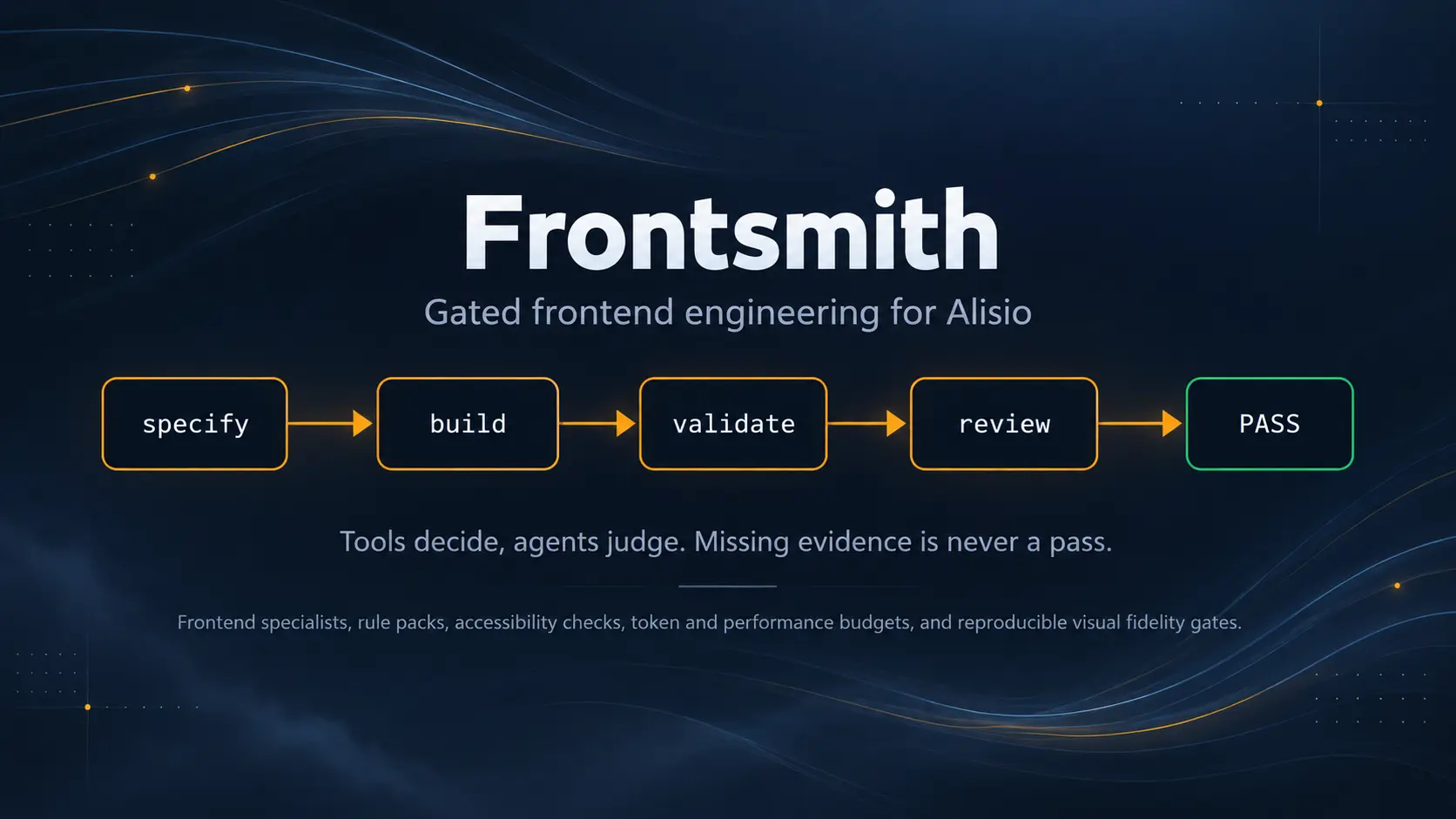
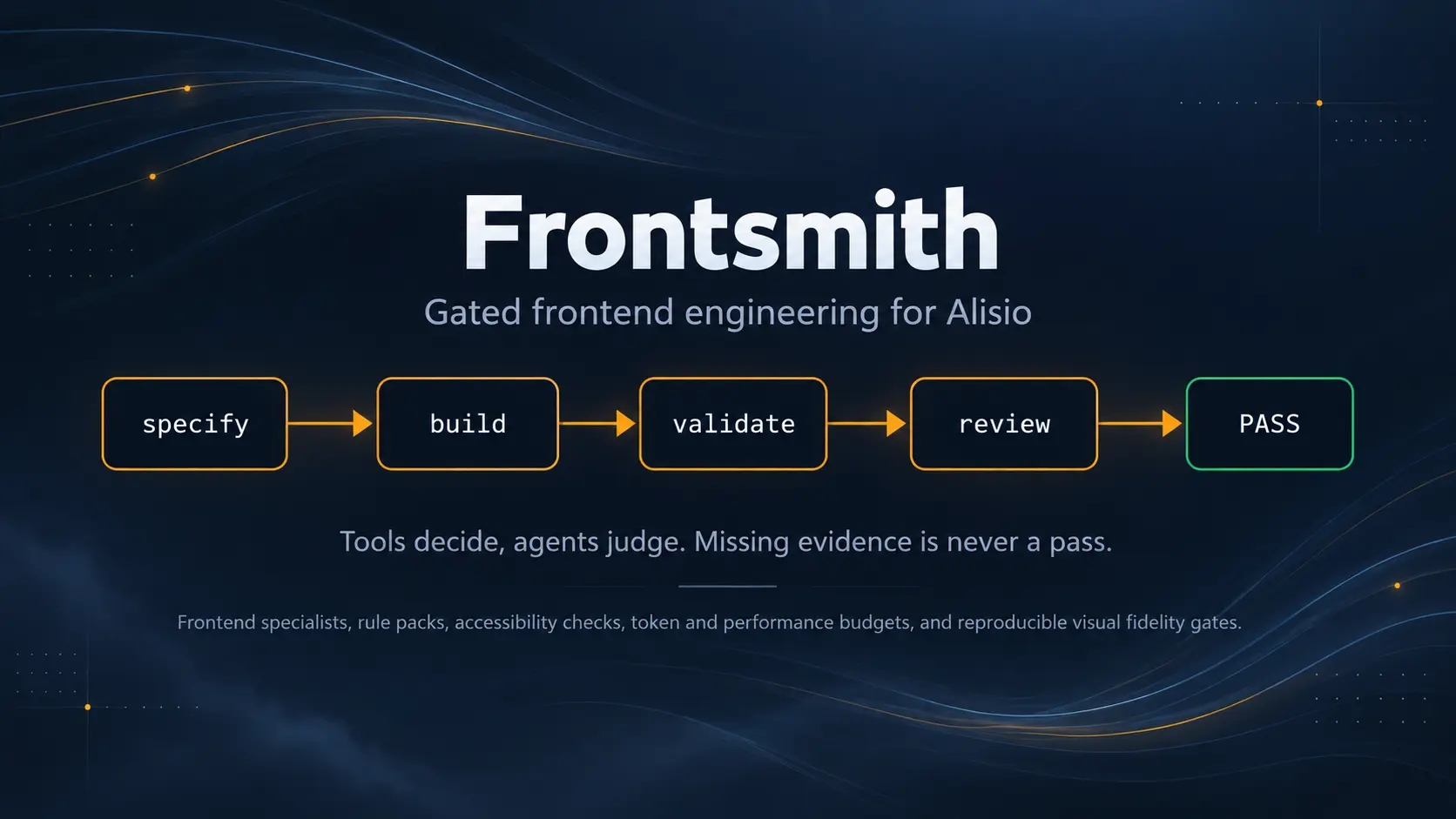
Frontsmith
Runs a gated frontend engineering workflow with specialist agents, deterministic rule packs, architecture, accessibility and token checks, and a reproducible visual-fidelity pipeline.
Install
alisio install npm:@alisio/plugin-frontsmith@0.6.3Metadata
| Package | @alisio/plugin-frontsmith |
|---|---|
| Version | 0.6.3 |
| Published | Nov 9, 2026 |
| Author | Alisio |
| License | MIT |
| Categories | Methodology harness |
| Size | 3.8 MB |
| Dependencies | 1 |
| Peer dependencies | 1 |
| Downloads (last month) | 602 |
| Source | First-party |
| Keywords | alisio-plugin, frontend, methodology, design-system, accessibility, visual-regression |
Español: README.es.md. The two READMEs must be updated together.
Frontsmith turns an Alisio session into a gated frontend engineering workflow. Specialist agents do the judgment and creation work; deterministic code decides everything that code can decide: rule packs, architecture boundaries, accessibility and token checks, performance budgets, and a reproducible visual-fidelity pipeline. Agents never approve their own work, and a missing tool is reported as blocked, never as a pass.
Status
Pre-release (0.2.0). Everything below is implemented and covered by offline tests with scripted fakes for the child sessions. What has not been exercised against a live Alisio host yet:
- real child sessions (the model-per-agent binding, the profiles of the agents, background jobs that outlive their command in the TUI, command time limits in a browser or a remote client);
- the conversational coordinator on a live host: which tools the model is offered (the host ignores the declared tool lists of a main agent for now), the plugin dialogs raised from inside a tool call, the completion notice queued for the next turn, and long checks inside a coordinator run;
- inline composite images in terminals, the dashboard through a remote web client, and how the Dock renders the Markdown artifacts;
- whether a vision model can read the fidelity captures (without one,
fs-fidelity-reviewerworks from the numeric report).
The real-browser probe ran once against Playwright and Chromium on Linux; it is skipped on machines that do not provide Playwright. Custom agents are planned, not shipped: see "Limitations".
Why it improves frontend quality

Each design choice is tied to a mechanism and to the outcome it protects, so a result is explainable rather than hoped for.
Requirements
- Node.js 22.16 or newer and
@alisio/sdk0.3 to 0.6. gitonPATH. Optional, resolved from your project:playwright(with a Chromium browser) for the fidelity pipeline andaxe-corefor runtime accessibility checks.- No credentials and no network access of its own.
Install
alisio install npm:@alisio/plugin-frontsmithQuick start
/frontsmith:initcreates.frontsmith/config.jsonand the gitignore entry for local evidence./frontsmith:doctorchecks git, Node, the project commands, Playwright, axe-core, packs and models./frontsmith:new login-form --level L1 -- Add an accessible login formcreates a feature. Without--levelan interactive session asks; a headless run needs the flag./frontsmith:next login-formruns the next unit. Planning phases run inline; build, validate and review start a background job (use--foregroundto run them inside the command).- When a unit waits for a person, the output names the exact command, for example
/frontsmith:approve login-form spec. Approvals are never defaulted: an interactive session asks, a headless one prints the command. /frontsmith:status login-formshows the phase, gates, tasks and the next command at any time.
To work in conversation instead, select the frontsmith:fs-coordinator agent (see "Conversational coordinator"). To start from a written spec, add --from-spec docs/login.md (see "Starting from a spec file").
Methodology

A feature moves through phases (intake, context, specify, ui-contract, tokens, plan, test-design, build, validate, review, accept, archive). Each phase ends in a gate whose report is written to docs/frontsmith//reports/. Failed gates send the work back in bounded loops: at most 2 bounces per task, 3 repair rounds, and 2 remediations, all configurable. The tokens phase runs only when the UI contract needs new tokens.
Agents

Agents return strict JSON envelopes that the code validates; the code, not the agent, writes artifacts and moves phases. The reviewer never sees the implementer's narrative.
| Agent | Role | Default tier |
|---|---|---|
fs-coordinator | Guides a person through a feature in chat by calling the fs_* tools; never decides a gate or records a human decision itself | standard |
fs-specifier | Turns an intent into a verifiable spec with states and open questions | reasoning |
fs-ui-contractor | Turns the spec and designs into an executable UI contract | reasoning |
fs-tokensmith | Chooses token roles, names and contrast pairs, never colour values | standard |
fs-architect | Minimal plan: components, layers, state, contracts, decisions, task contracts | reasoning |
fs-test-engineer | Maps each acceptance criterion to a test; writes verification tests in build mode | standard |
fs-implementer | Implements one UI task, test first where required | standard |
fs-data-engineer | Implements one data-layer task: clients, stores, queries, mocks | standard |
fs-a11y-auditor | Interprets accessibility reports, keyboard and focus behaviour | standard |
fs-fidelity-reviewer | Classifies review items of the fidelity report and orders repairs | standard |
fs-reviewer | Independently tries to refute that the change is ready | reasoning |
fs-archivist | Writes the retrospective and proposes rule candidates | fast |
The agent and skill files ship in the package (.agents/agents, .agents/skills, 16 skills) and are used both for the host catalog and for the instructions of each child session.
Who decides what

Code decides what code can measure. Agents classify heuristic signals (REVIEW) and can mark a variation as acceptable, but they cannot overturn a FAIL. A required tool that is missing gives BLOCKED, which stays visible until a person resolves or waives it.
Conversational coordinator
Select the frontsmith:fs-coordinator agent (/agent:frontsmith:fs-coordinator or Shift+Tab) and talk. It reads the state with fs_status, then calls fs_feature_new, fs_next, fs_answer and fs_approval_request in the right order and explains each result. Code still runs every unit and every gate; the coordinator only sequences them.
- Every human decision stays human. The level of a new feature, an answer to an open question and an approval are recorded only after the person clicks in a dialog that the plugin builds and shows (or types the command). The model never fills these dialogs. Text it relays for you, such as an answer in your own words, is shown back to you exactly and recorded only if you choose Record. A session that cannot ask gets the exact command back and nothing is recorded.
- Approvals.
fs_approval_requestopens the same dialog as/frontsmith:approve, only for the approval the feature currently owes.configapprovals (re-baselining protected files) are command-only. - Long work runs as background jobs. Every unit that runs a child agent starts as a job. When it ends a short notice (written by code, with no agent text) is queued for the next turn, and the coordinator waits for you to say continue. It never polls.
- Stops at gates.
fs_nextreturns without running anything while a question, an approval or a closed feature is waiting for you. At most three units run per turn. - Footer. Every reply ends with
Feature, Phase, Gate, Next, taken from the status.
Known limit: the host does not yet honor the tool allow and deny lists declared in the agent file for a main agent, so readOnly: false also exposes the built-in write, shell and delegation tools to it. The lists are kept in the file for the day it does, and the guard today is the agent body, the host's per-call approvals, protected-file hashing and the plugin dialogs. A host request is documented in the spec (section 5.2). Custom agents are not part of this release.
Starting from a spec file
/frontsmith:new --level L1|L2|L3 --from-spec (or fromSpec on fs_feature_new) creates a feature from a document you already have. -- becomes optional; without it the intent is the title of the file.
- The file must be inside the workspace, end in
.md,.markdownor.json, and be at most 128 KiB of UTF-8..git,.alisio, absolute paths and links that leave the workspace are refused. A path with spaces needs the tool form. L0 cannot take a spec (it has no specify phase). - The file is copied to
docs/frontsmith//source-spec.md(or.json) and hashed; later edits of the original do not change the run. The copy is protected: if it changes, the units that use it areBLOCKED. - Markdown goes to
fs-specifier, which normalizes it into the spec envelope: nothing is dropped silently, implementation statements become assumptions, and ambiguities, contradictions and TBDs become open questions that block gate G1 until you answer them. - A
.jsonfile that is already a valid spec envelope skips only the specifier run. Gate G1 still runs, and spec approval at L1 and above still applies. It cannot be combined with L0.
Rigor levels
| Level | For | Phases | Human approvals |
|---|---|---|---|
| L0 trivial | A typo, copy or local tweak | intake, context, build, validate, review | none |
| L1 small feature | A contained change | adds specify and a task plan | spec |
| L2 product feature | A normal feature | all phases | spec, UI contract, plan, acceptance |
| L3 high risk | Security, privacy or wide impact | as L2, two reviews, a decision record and a security or privacy risk | L2 plus a review sign-off |
Modes are build (default), replicate, refine and redesign; replicate needs at least one reference file in the UI contract.
Commands
All commands are /frontsmith: and return a usage line when an argument is wrong.
| Command | Arguments | Purpose |
|---|---|---|
init | Create the project config and the gitignore entry | |
doctor | Check what a run needs | |
new | [--level L0-L3] [--mode ...] [--from-spec ] -- | Create a feature, optionally from a spec file |
status | [feature] | Show one feature or list them |
next | [--foreground] | Run the next unit |
answer | -- | Answer an open question |
approve | spec|ui-contract|plan|acceptance|config|review-signoff|dependency | Record a human approval |
reject | spec|ui-contract|plan|acceptance -- | Send the comments back to the producing phase |
waive | --until -- | Waive a rule on some paths until a date |
verify-manual | -- | Record manual evidence for a criterion |
stop | `` | Abort the running job |
resume | `` | Re-run an interrupted unit |
check | [--task T-001] | Run one gate ad hoc |
rules | list [pack] | explain | test | promote | Browse and manage rules |
arch | init [preset] | check | Architecture configuration |
tokens | check | generate --family | Check tokens or generate a palette |
fidelity | run [cases] | calibrate | Visual-fidelity run and calibration |
baseline | approve [caseId] | list | Approve reviewed captures as baselines |
budget | check | baseline | Performance budgets |
models | [check | set | unset | reset | pick | explain] | Per-agent model configuration |
dashboard | [feature] | Print the URL of the local review dashboard |
Tools
| Tool | Effect | Purpose |
|---|---|---|
fs_status | read | Phase, gates, tasks and next command, or the feature list; with a feature it adds a JSON view for the coordinator |
fs_feature_new | write | Create a feature (optionally from a spec file); the person picks the level in a dialog |
fs_answer | write | Relay an answer; recorded only after the person confirms in a dialog |
fs_approval_request | write | Open the approve/reject dialog for the approval currently owed (never config) |
fs_next | process | Advance one unit: stops at human gates, child units start as background jobs |
fs_detect_stack | read | Package manager, framework, styling and test tooling with evidence |
fs_inventory | read | Components, hooks, stores and design tokens |
fs_rules_list | read | Active rules, with resolution trails |
fs_rules_check | read | Run the rule packs over the workspace |
fs_architecture_check | read | Check imports against .frontsmith/architecture.json |
fs_tokens_check | read | Check tokens, themes and required contrast pairs |
fs_contrast | read | WCAG 2.2 contrast for colour pairs |
fs_palette_generate | read | Deterministic palette from the curated catalog |
fs_models | read | The model and source layer of every agent |
fs_gate_run | process | Run one gate and return its report |
fs_phase_run | process | Run the next unit in the agent loop, with progress |
fs_budget_check | process | Check budgets, optionally building first |
fs_fidelity_run | process | Measure and compare the rendered feature |
fs_a11y_run | process | Runtime accessibility checks (axe-core) |
Configuration
.frontsmith/config.json is optional except for schemaVersion; unknown keys are rejected with a diagnostic that names the JSON pointer. A JSON Schema for editors ships in schemas/.
{
  "schemaVersion": 1,
  "paths": {
    "artifacts": "docs/frontsmith",
    "sourceRoots": ["src"],
    "themeOutput": "src/styles/frontsmith-tokens.css",
    "tokenFiles": ["src/styles/**/*.css"]
  },
  "defaults": { "level": "L2", "mode": "build" },
  "commands": {
    "typecheck": ["pnpm", "typecheck"],
    "lint": ["pnpm", "lint"],
    "test": ["pnpm", "test"],
    "testRelated": ["pnpm", "vitest", "related", "--run", "{files}"],
    "build": ["pnpm", "build"]
  },
  "accessibility": { "target": "AA" },
  "fidelity": {
    "baseUrl": "http://127.0.0.1:5173",
    "serve": {
      "command": ["pnpm", "dev", "--port", "5173", "--strictPort"],
      "readyUrl": "http://127.0.0.1:5173/",
      "timeoutMs": 60000
    }
  },
  "limits": { "maxBounces": 2, "maxRepairRounds": 3, "maxRemediations": 2 },
  "dashboard": { "enabled": true }
}
Commands are argv arrays, never shell strings. Missing commands are inferred from package.json scripts and reported with their source. defaults.level only preselects the interactive option; a headless new still needs --level. The files under .frontsmith/ are protected: a child session that changes them raises a blocker until a person runs /frontsmith:approve config.
Model configuration

Every agent has a tier (reasoning, standard, fast) and every tier defaults to inherit, which uses the model of your session. The plugin cannot know your providers, so binding models is yours. Five layers apply, highest first: a runtime override (/frontsmith:models set), a fenced block in the project AGENTS.md, the models key of .frontsmith/config.json, the host plugin options, and the default. Reasoning effort is not part of the host child-session contract, so only models are bound.
```frontsmith-models
tier.reasoning = openrouter/anthropic/claude-opus-4.1
tier.standard  = inherit
tier.fast      = openrouter/google/gemini-2.5-flash
agent.fs-reviewer    = @reasoning
agent.fs-implementer = openai/gpt-5-codex
```
/frontsmith:models shows the effective model and the layer that produced it for each agent, /frontsmith:models check validates every selector with the host, and an invalid layer fails closed with a diagnostic that names it.
Rule packs

Rules are data: JSON packs evaluated by a closed set of 20 engines. Fifteen packs ship with 130 rules (91 deterministic, 39 advisory): accessibility, architecture, components, CSS, Tailwind, tokens, performance, testing, governance, design heuristics and the framework packs for React, Next.js, Vue, Svelte and Angular. A project adds packs under .frontsmith/packs//pack.json, extends or overrides shipped rules with a justification, and silences a minor rule on one line:
/* frontsmith-disable-next-line FS-TOK-002 -- legacy spacing scale kept until the redesign */Blocker and major rules cannot be suppressed; a human waiver (/frontsmith:waive) with an expiry date covers those. alisio-frontsmith check and /frontsmith:rules list|explain|test|promote browse them.
Architecture presets
/frontsmith:arch init [preset] writes .frontsmith/architecture.json from one of four presets: feature-sliced, hexagonal, layered or atomic. The check reports forbidden layer directions, cross-slice imports, imports that bypass a public API, cycles (each reported once with its members), role violations and unmapped files, and resolves tsconfig paths and package imports. A catalog of 18 patterns is available to the architect, each verified by shipped rules where possible.
Visual fidelity

The pipeline renders the real feature in Chromium at the viewports of the UI contract and measures the rendered elements against the contract; it then compares regions with human-approved baselines. It reports local defects that a single global score would hide. Baselines are approved by a person (/frontsmith:baseline approve, never during acceptance) and are valid only for the recorded browser version and operating system. /frontsmith:fidelity calibrate repeats unchanged captures and injects known defects to derive thresholds; until a region is calibrated its result is REVIEW, never PASS. Without Playwright, a browser, a baseline or a calibrated oracle the check is BLOCKED.
Status and resume

State lives in docs/frontsmith// and .frontsmith/; writes are atomic and one job per feature runs at a time. After a host restart, an attempt that was running becomes interrupted and /frontsmith:resume re-runs that unit from its start. State written by a newer Frontsmith is read-only.
TUI and web
Commands return Markdown with headings, lists, pipe tables and links; tools return a short text summary first, then the primary block for that tool, then the primary image. Human approvals ask through the host question UI with the recommended option marked, and when nothing can answer, the output shows the exact command to run. The TUI also shows the running phase and job in its footer.
/frontsmith:dashboard [feature] starts a review dashboard on 127.0.0.1 with a gate board, the fidelity composites (reference, actual and diff side by side), the active rules, and approve, reject and baseline buttons. It uses a random per-run token exchanged for a cookie, checks the Host and Origin headers, sets a strict Content-Security-Policy and needs the token in a header for every change. It is optional (dashboard.enabled) and only reachable from the machine that runs Alisio; through a remote web client use the Dock previews and the tool images instead.
CLI and CI
alisio-frontsmith runs the deterministic part without a session: detect, check, arch, tokens, contrast, palette, models, gate, fidelity, budget and doctor. Gates that need agents report those checks as skipped. Exit codes: 0 PASS, 1 FAIL, 2 usage or environment error, 3 BLOCKED, 4 REVIEW only; --json prints the machine-readable report.
npx alisio-frontsmith check . --json
npx alisio-frontsmith gate login-form G7 . --json
Architecture

Commands, tools, the CLI and the dashboard are thin front ends over one services facade, so they cannot drift apart. Dependencies point inward: the domain imports nothing from Node or the host, and the package runs its own architecture checker over its sources in a test.
Security
- Identifiers are validated and paths are contained in the workspace; symlink escapes are refused.
- No shell is used anywhere: project commands are argv arrays with timeouts, output caps and a scrubbed environment, and never run while a protected file is tampered with.
- Child output is untrusted: strict envelopes, size caps, unknown keys rejected, never executed and never rendered as HTML.
- The browser probe only visits the configured loopback
baseUrland blocks other origins unless the contract lists them. Evidence stays in the git-ignored.alisio/frontsmith/. - The dashboard binds to loopback only and protects every request as described above.
Limitations
- Pre-release: see "Status" for what has only been verified with fakes.
- The coordinator's declared tool lists are not honored by the host for main agents yet (see "Conversational coordinator").
- Custom agents are planned, not shipped. The
agents.customkey is accepted so that model bindings can already name an agent, but no custom agent is loaded or run in this release. - Flow-annotated JavaScript is not parsed; unparsable files are reported for review and skipped.
- Line-count checks in the fidelity pipeline are approximate and map to
REVIEW. - Baselines are not portable across browser versions or operating systems.
License
MIT