
Cardsmith
Generates finished card images from chat requests: social cards, certificates, badges, banners, photo composites, charts and dynamic data cards.

Install
alisio install npm:@alisio/plugin-cardsmith@0.5.3Metadata
| Package | @alisio/plugin-cardsmith |
|---|---|
| Version | 0.5.3 |
| Published | Nov 9, 2026 |
| Author | Alisio |
| License | MIT |
| Categories | Tools |
| Size | 4.4 MB |
| Dependencies | 1 |
| Peer dependencies | 1 |
| Downloads (last month) | 611 |
| Source | First-party |
| Keywords | alisio-plugin, images, cards, templates, png |

Español: README.es.md. The two READMEs must be updated together.
Cardsmith interprets a chat request into validated, locally rendered card images: social cards, certificates, badges, banners, photo composites, charts and dynamic data cards. The model writes text only; templates, palettes and fonts are local resources and the plugin draws the pixels.
Examples
Every card is a validated local render — the model only wrote the text.

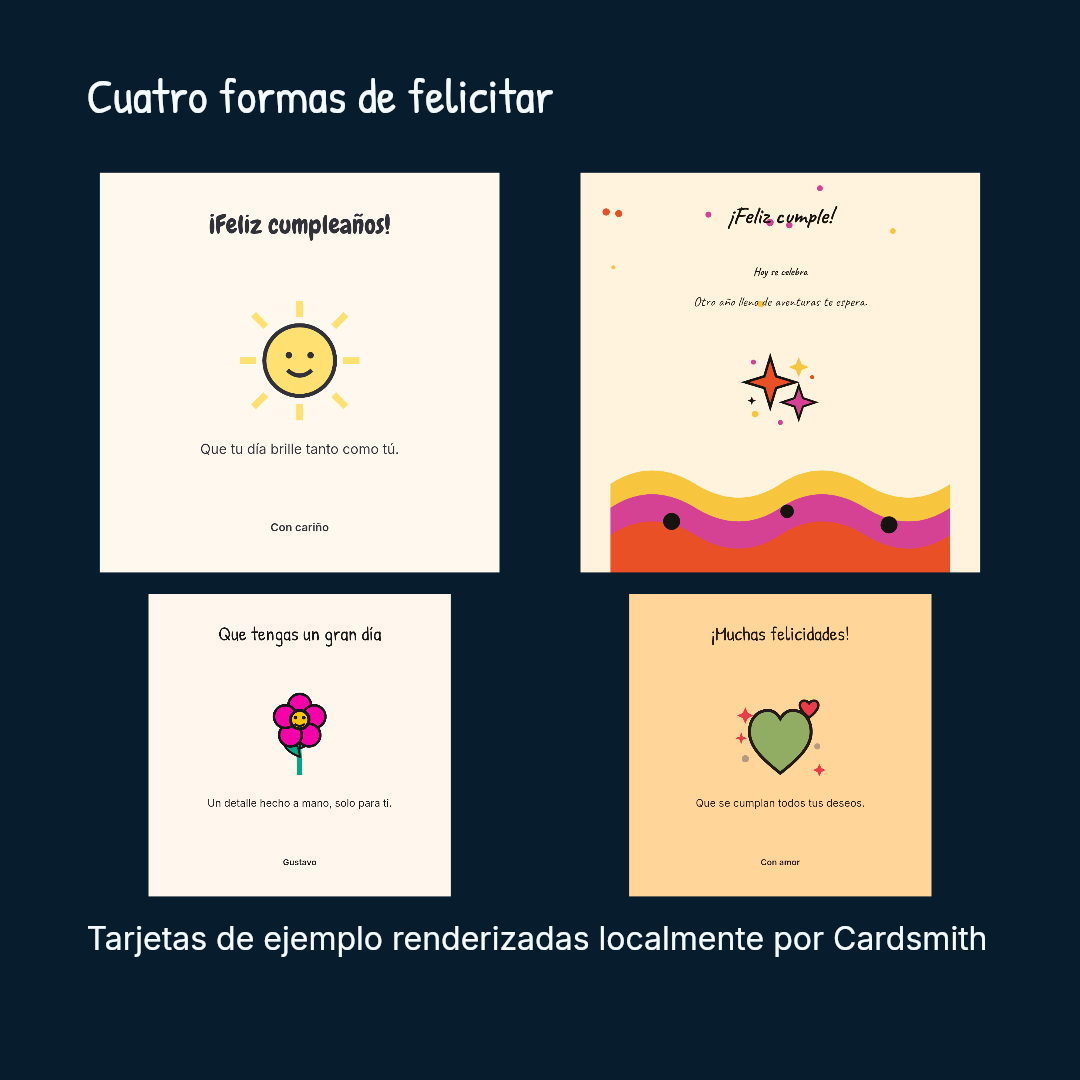
The four cards and the collage come from samples/generate-readme-cards.mjs; the renderer is deterministic, so rerunning the script reproduces byte-identical PNGs.
Install
alisio install npm:@alisio/plugin-cardsmithTools
| Tool | Effect | What it does |
|---|---|---|
card_catalog | read | Lists template ids with compatible sizes, required fields and feature flags, plus palette, font pair, size and format ids. |
card_design | write | Validates a design spec and persists a draft with a revision. No pixels yet. |
card_update | write | Patches a draft with the revision you last saw (expectedRevision); content merges per key. Deterministic, no model call. |
card_render | write | Renders preview while iterating or the exportable final; publishes an artifact when the host bridge is available. |
card_export | write | Copies the final image into the workspace; move deletes the working file only after a verified copy. |
A chat walkthrough
User. Make a birthday card for my sister Ana.
- Design.
card_designwith familysocial, templateIdillustrated-greetingandcontent: { title: "¡Feliz cumpleaños, Ana!", message: "Que tengas un día enorme.", author: "Con cariño" }. Cardsmith answersdraft revision 1: created social/illustrated-greeting at social-portrait 1080x1350, palette alegria-botanica, format png. - Recolor. “Make it warmer” becomes
card_updatewithexpectedRevision: 1andpatch: { paletteId: "amor-calido" }. Palette, size and font changes are deterministic and never require another model call or a hand-made render. - Render.
card_renderwithmode: "preview"shows a small image in chat; when the user is happy,mode: "final"renders the exportable PNG (JPEG on request). - Save.
card_exportwithpath: "assets/ana-birthday.png"copies the final image into the workspace. Download saves to the user's browser; export writes to the Alisio server workspace.moveis used only when asked.
What ships
Sixteen templates across five families:
- social —
editorial-photo,illustrated-greeting,retro-message,metric-summary - personalized —
certificate-classic,badge-clean,banner-promo - composite —
photo-caption,watermark,image-collage - chart —
bar,line,scatter,donut - dynamic —
inventory-product,status-card
Plus six palettes, 39 palette-recolorable illustrations — 28 original in-house pieces plus ten CC0 imports and one CC BY 4.0 Twemoji cherry blossom, credited in THIRD_PARTY_NOTICES.md — nine static TTF files in six font pairs and a vendored QR code generator. Every resource is versioned inside the package, nothing is fetched at render time, and system fonts are never used.
How rendering works
Images are rendered on this machine with @napi-rs/canvas (Skia-backed). The package ships its own templates, palettes and static TTF fonts; it never downloads resources while rendering and does not depend on fonts installed on the system.
@napi-rs/canvas is a deliberate, documented exception to the repository's "Node built-ins and @alisio/sdk only" dependency policy: professional text shaping and rasterization are not achievable with Node built-ins alone, and the package ships platform-specific prebuilt binaries. THIRD_PARTY_NOTICES.md records that exception and audits the full dependency set, including the vendored QR code generator and every shipped font file with its SHA-256.
Determinism, cache and limits
- Same input, same bytes: a fixed environment (renderer, template, fonts, resources and image bytes) reproduces the same image for the same spec and seed. No timestamps reach the scene.
- One render is capped at 12 MP; input images at 20 MB each and 60 MB total, checked before and after decoding.
- Renders run two at a time through a bounded queue; the SHA-256 cache reuses identical renders.
- QR codes draw whole modules with a quiet zone and at least 4 px per module, or fail with
QR_TOO_DENSE. - Drafts, working files and the cache live under the plugin state directory (
.alisio/cardsmithin the workspace when the host exposes noapi.paths).
Headless and TUI notes
Tool results are compact text: ids, revisions, dimensions, palette and font names, warnings and actionable error codes. Rendered images travel as image parts (base64 in the tool result), and no dialog or widget ever blocks headless execution; without the artifact bridge, card_render still returns the image and reports the limitation precisely.
External renderer
@alisio/plugin-cardsmith/renderer renders one design spec without Alisio, plugin setup or the SDK, so an application can serve cards from its own authenticated endpoint:
import { renderCard } from "@alisio/plugin-cardsmith/renderer";

const card = await renderCard({
  family: "dynamic",
  templateId: "inventory-product",
  content: { productName: "Runner 2", price: "89.90", currency: "EUR", sku: "RS-2" },
});
// card.bytes: PNG/JPEG bytes — card.width, card.height, card.mimeType, card.warnings
For a GET /api/products/:id/card.png-style endpoint, createCardRequestHandler adapts the renderer over node:http: GET and HEAD only, ETag from the image hash and a private cache policy (never public, because the data is), while your CardEndpoint owns authentication, data and error codes:
import { createServer } from "node:http";
import { createCardRequestHandler, renderCard, type CardEndpoint } from "@alisio/plugin-cardsmith/renderer";

const endpoint: CardEndpoint = {
  async handle({ url }) {
    const product = await findProduct(url.pathname); // host app: auth + data
    if (product === undefined) return { status: "not-found" };
    return { status: "ok", rendered: await renderCard({
      family: "dynamic", templateId: "inventory-product",
      content: { productName: product.name, price: product.price },
    }) };
  },
};
createServer(createCardRequestHandler(endpoint)).listen(3000);
Development
pnpm --filter @alisio/plugin-cardsmith build
pnpm --filter @alisio/plugin-cardsmith typecheck
pnpm --filter @alisio/plugin-cardsmith test
node packages/plugin-cardsmith/samples/generate-readme-cards.mjs  # regenerate the Examples images
pnpm check  # lint, leak, typecheck, test, build and pack:check for the whole repository
Status
0.1.0: all five families render final images and the five tools design, update, render and export them. Artifact publishing depends on the host bridge for external plugins; without it the image still renders, exports to the workspace and reports the limitation.
License
MIT. Third-party components and their licenses are listed in THIRD_PARTY_NOTICES.md.